Product Introduction
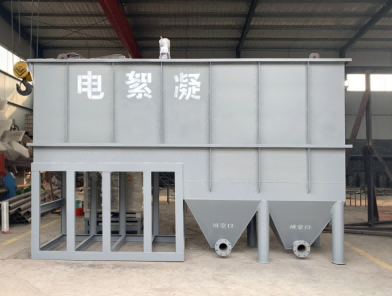
The electrocoagulation device is a water treatment equipment based on electrochemical principles, which uses soluble metals such as aluminum and iron as anodes. Under the action of direct current, metal ions are generated through electrode reactions, which are hydrolyzed and polymerized to form multi-core hydroxyl complexes with strong adsorption ability. The colloidal particles are stabilized and condensed, and pollutants are removed through anodic oxidation, cathodic reduction, and electrolysis to produce fine bubbles. The product types include traditional plate and frame electrocoagulation reactors, high-voltage pulse electrocoagulation equipment (high voltage and low current), electrocoagulation air flotation integrated equipment, vertical cylindrical reactors, and modular closed reactors. The equipment mainly consists of an electrolytic reaction chamber, an electrode plate group, a DC power supply or pulse power supply, a stirring system, a precipitation separation unit, and a PLC control system. This device integrates electrolytic oxidation, electrolytic reduction, electrolytic flocculation, and electrolytic air flotation, and the entire reaction process does not require the addition of additional chemical flocculants.
Process Selection
1. Selection based on water quality: For wastewater containing heavy metals, iron plate electrode electrocoagulation devices are preferred for low treatment costs and good results; Aluminum plate electrodes are used for oily wastewater and high chromaticity wastewater, with dense flocs and excellent air flotation effect; The use of pulse power electric flocculation device for difficult to degrade organic wastewater has stronger oxidation ability.
2. Selection based on processing scale: For small-scale projects or emergency treatment with a daily processing capacity of less than 100m ³, an integrated mobile electrocoagulation device should be selected; For medium-sized projects with a daily processing capacity of 100-1000m ³, modular continuous flow devices are selected; For large-scale projects with a daily processing capacity>1000m ³, multiple sets of parallel large-scale electrolytic cell systems are used.
3. Selection by processing stage: As a pretreatment unit, it is used to remove heavy metals, oils, and suspended solids, reducing the burden of subsequent biochemical treatment; As a deep processing unit, it is used to remove residual COD, chromaticity, and total phosphorus from biochemical effluent; As an emergency response unit, it is used for rapid disposal of sudden water pollution incidents.
4. Selection based on process combination: For high concentration organic wastewater, a combination process of "electrocoagulation+biochemical treatment" should be used; Chromium containing wastewater needs to undergo reduction reaction before electrocoagulation; Projects with high effluent requirements can adopt a combination process of "electrocoagulation+filtration" or "electrocoagulation+activated carbon adsorption".




 CN
CN

 National Service Hotline:400-611-6861