CN

Product Center

Green Innovation · Scientific and Technological Development · Industrial Responsibility · Joint Construction of Civilized Ecology

Dissolved Air Flotation Machine
The core value of the Dissolved Air Flotation (DAF) machine lies in its ability to treat "lightweight" pollutants that are not effectively removed by conventional sedimentation methods. Its main application scenarios include the following categories: Industrial Wastewater Treatment: It delivers remarkable results for wastewater containing oil, fibers, and high organic matter. Oily Wastewater: Such as wastewater from petrochemical plants, mechanical processing, and slaughterhouses — effectively achieves oil-water separation. High-Suspended-Solids Wastewater: Such as wastewater from papermaking, printing and dyeing, and textile industries — removes short fibers, dye particles, etc., and can also recover pulp fibers. High-Concentration Organic Wastewater: Such as wastewater from brewing, food processing, and tanneries — significantly reduces COD and suspended solids loads. Heavy Metal Wastewater: Such as electroplating and pickling wastewater — removes heavy metal ions when combined with chemical treatment methods.
National Service Hotline:400-611-6861
Product Introduction

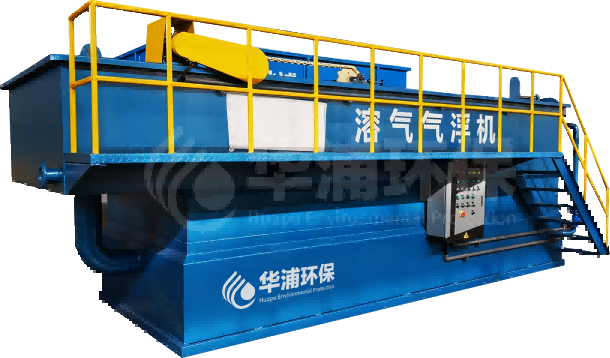
The Dissolved Air Flotation (DAF) machine is a water treatment device that generates microbubbles through the principle of "pressurized dissolution and atmospheric release" to efficiently separate suspended solids, oils, and colloids from water. It is widely used in industrial wastewater treatment and water purification.

The DAF machine mainly consists of three components: the dissolution system, the release system, and the flotation separation zone.

Dissolution: Through a dissolution pump and an air compressor, air is forcibly dissolved into water within a pressurized tank (typically at 0.3–0.6 MPa), forming pressurized dissolved-air water.

Release: The pressurized dissolved-air water enters the atmospheric flotation tank, where the sudden pressure drop causes supersaturated air to precipitate out, forming a large number of microbubbles with diameters of 20–50 micrometers. This bubble size is the key to efficient separation.

Separation: The microbubbles attach to impurities such as suspended solids and oil droplets in the water, reducing their overall density to below that of water. These impurities then rapidly rise to the surface to form a scum layer, which is removed by a skimmer, while the clarified water is discharged from the bottom.

The main body of the equipment is typically a rectangular or cylindrical steel structure, with treatment capacities ranging from a few tons per hour to several hundred tons per hour.

Technical Advantage
High separation efficiency
The microbubbles are extremely fine and uniform, providing a large contact area with impurities and strong adhesion. The removal rate of suspended solids (SS) can reach over 93%–95%, far exceeding that of conventional sedimentation.
Wide applicability
It can effectively treat light-weight and colloidal pollutants that are difficult to handle with traditional methods, such as emulsified oil, fine fibers, algae, and the like.
Stable and reliable operation
The process is mature and highly automated, requiring relatively straightforward operation and maintenance while effectively preventing sludge bulking.