CN

Product Center

Green Innovation · Scientific and Technological Development · Industrial Responsibility · Joint Construction of Civilized Ecology

High-efficiency sedimentation tank

Efficient sedimentation tank is an efficient physical and chemical treatment process widely used in the deep treatment and upgrading of municipal sewage treatment plants (especially in the first level A standards that require stable SS and TP effluent), purification of drinking water sources, pre-treatment of reclaimed water reuse projects, and industrial wastewater treatment. In terms of industrial wastewater, it can be applied to zero discharge pretreatment of coal mine water treatment, steel rolling wastewater, food processing wastewater, and coal chemical wastewater. It can also be used for wastewater treatment in metallurgy, pharmaceuticals, and chemical industries, as well as rainwater collection and treatment, power plant cooling and circulating water treatment, etc. This process is particularly suitable for complex water quality such as high turbidity (such as raw water turbidity>1000NTU in the water source area), low temperature and low turbidity, as well as engineering scenarios where the inflow water quality and quantity fluctuate greatly, land is tight, and highly integrated treatment is required.

National Service Hotline:400-611-6861
Product Introduction

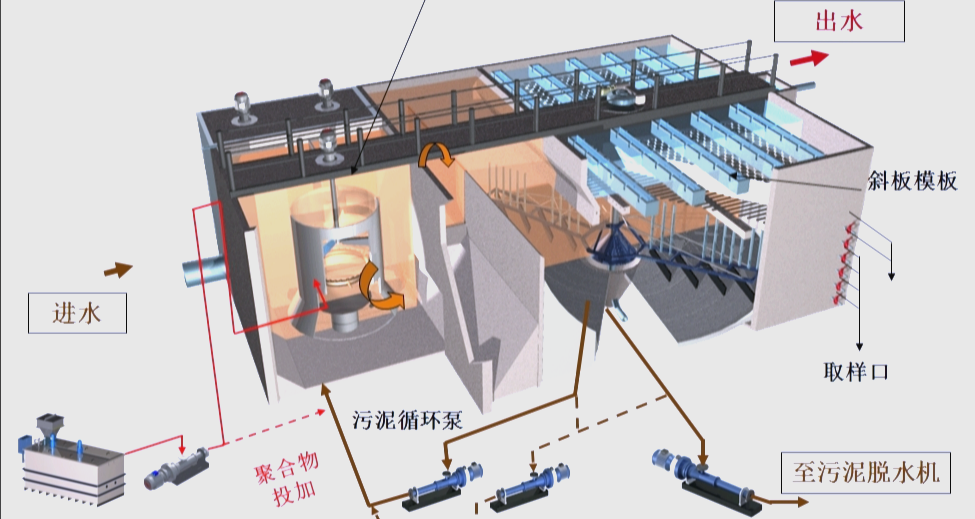
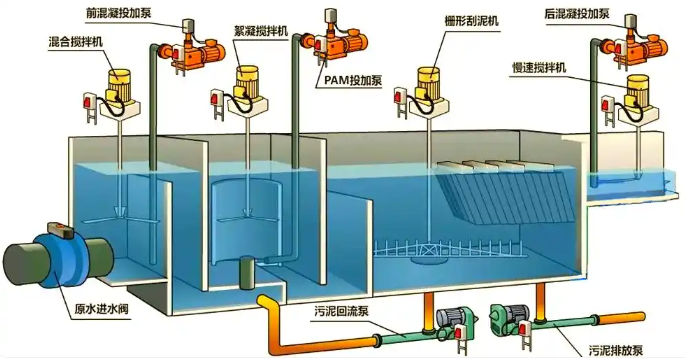
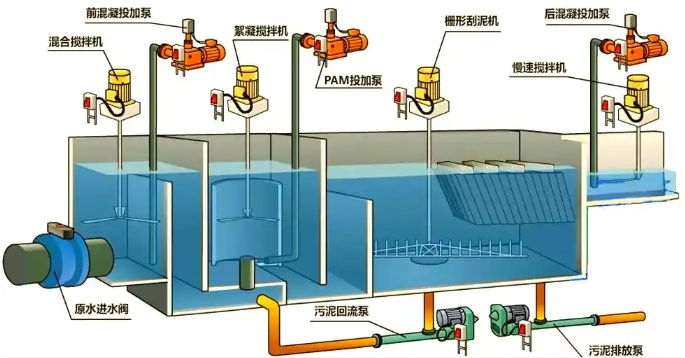
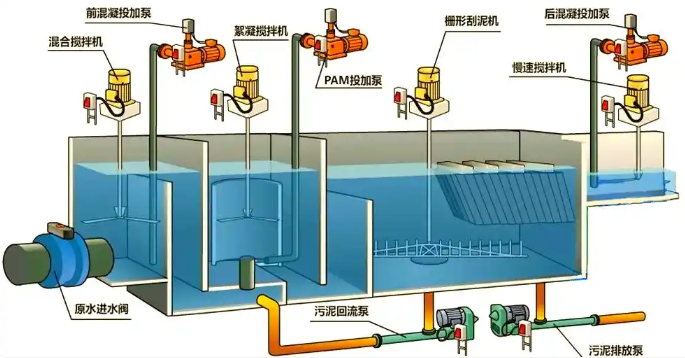
The high-efficiency sedimentation tank is a clarification and sedimentation device based on the three-stage integrated design of "sludge flocculation inclined tube sedimentation sludge concentration". It mainly achieves efficient removal of turbidity, suspended solids, and some chemical oxygen demand through processes such as physical and chemical coagulation, inclined tube sedimentation, and sludge water circulation separation. The equipment mainly consists of mixing unit, flocculation unit, inclined tube sedimentation and sludge concentration unit, external sludge reflux and discharge control system, and is equipped with mechanical equipment such as agitator, scraper, and water collection system. According to the process route, it can be divided into three categories: traditional high-efficiency sedimentation tank, high-density sedimentation tank, and carrier flocculation sedimentation tank.

Technical Advantage
High processing efficiency and high load
The sedimentation rate is more than 8-10 times that of ordinary sedimentation tanks. The surface hydraulic load of traditional high-efficiency sedimentation tanks can reach 10-20m ³/(m ² · h), and high-density sedimentation tanks can reach 20-45m ³/(m ² · h); The Actiflo process uses a micro sand carrier with a surface load of up to 80-120m/h, suitable for high turbidity water sources.
Excellent and stable effluent quality
suspended solids removal rate can reach over 95%, and turbidity can be reduced to below 1NTU; The turbidity of the effluent from DensaDeg clarification tank can remain stable below 1NTU; The total phosphorus in the effluent of the Multiflo sedimentation tank can be stably below 0.3mg/L, and the suspended solids can be below 8mg/L, fully meeting the first-class A standard.
Strong ability to withstand impact loads
Not sensitive to fluctuations in raw water turbidity, with outstanding adaptability under low temperature and low turbidity conditions; The Actiflo process adapts to water quality fluctuations by adjusting the micro sand reflux rate, and can achieve effluent turbidity ≤ 2NTU when treating coal mine wastewater (SS 3000-5000mg/L).
Small footprint and high integration
The high-efficiency sedimentation tank process occupies only 1/10 to 1/3 of the traditional process, while the cylindrical structure has a higher integration. Actiflo occupies only 20% of the traditional sedimentation process, making it suitable for land intensive renovation and new construction projects.
Low operating cost
saving 10% to 30% of chemicals through sludge recirculation; The recovery rate of Actiflo micro sand can reach over 95%; The magnetic powder recovery rate of the magnetic coagulation process exceeds 99%, and the carrier loss rate is low; High sludge concentration (generally above 20g/L) reduces sludge treatment capacity and water loss.
High degree of automation
All stages of mixing, dosing, scraping, and discharging are integrated with PLC automatic control, ensuring stable and reliable operation. It can be remotely monitored by an upper computer to reduce manual intervention.
Process Selection

1. Selection based on water quality: Standard high-efficiency sedimentation tanks are selected for municipal water supply and low turbidity raw water treatment; High turbidity raw water and wastewater with high sand content should be treated with a reinforced high-efficiency sedimentation tank with a pre sedimentation zone; Efficient sedimentation tanks with chemical phosphorus removal function are selected for the deep treatment of municipal and industrial wastewater.

2. Selection based on processing scale: For small-scale projects with a daily processing capacity of less than 50000 tons, single tank high-efficiency sedimentation tanks are selected; For medium-sized projects with a daily processing capacity of 50000 to 200000 tons, a dual tank parallel connection is selected; Large scale projects with a daily processing capacity greater than 200000 tons adopt a multi pool modular combination design.

3. Select according to the effluent requirements: Select the basic configuration based on the first level A standard for effluent requirements; High precision inclined tube packing and optimized flocculation system should be selected for effluent requirements of Class IV or above standards; The reclaimed water reuse project requires additional supporting filtration processes.

4. Selection according to renovation requirements: The existing traditional sedimentation tank renovation can adopt the solution of "installing high-efficiency flocculation modules inside the tank+inclined pipes+sludge reflux system", which can increase the treatment capacity by 2-3 times; Priority will be given to the design of reinforced concrete integrated pool bodies for new construction projects.


Equipment Selection

Parameter Description and Selection Points

The type of reactor is selected according to the process route: mixing reactor (rapid coagulation), flocculation reactor (with agitator and guide tube), inclined tube sedimentation tank (equipped with inclined tube components and water collection system), sludge concentration system (scraper, sludge reflux and discharge system), and optional carrier reaction and recovery system (hydraulic cyclone, micro sand/magnetic powder feeding and recovery device)

The processing scale is determined based on Q m ³/d to determine the load of each unit, and the area is rechecked by surface hydraulic load; Each unit equipment needs to match the peak flow coefficient and have the ability to combine multiple parallel or modular groups

The mixing and flocculation agitator typically operates at a speed of 300-1500rpm to meet high-speed mixing requirements; Low speed agitator (20-80rpm) in the flocculation zone to avoid floc breakage; The underwater parts of the shaft and impeller are made of stainless steel material, and the motor is outdoor with better frequency conversion speed regulation

The selection of scraper is matched with central or peripheral drive scraper, with an outer edge linear speed of ≤ 3m/min; The scraper plate is designed with logarithmic spiral lines, ensuring thorough sludge discharge and equipped with torque overload protection; The underwater part is made of stainless steel or highly corrosion-resistant materials

The carrier separation equipment for micro sand process uses hydraulic cyclones and sand water separators to ensure a micro sand recovery rate of ≥ 95%; The magnetic coagulation process uses magnetic separation drums or high gradient magnetic separators, with a recovery rate of ≥ 99%

The annual loss rate of carriers in the carrier replenishment system is generally 5% to 10%, and carrier storage tanks and quantitative feeding devices need to be installed for regular replenishment; The carrier material can be quartz sand or ceramic sand (micro sand), or magnetite powder (magnetic powder)

Selection of inclined pipe components: inclined pipe aperture 50-80mm, inclination angle 60 °, pipe length 1000-1500mm, material PP/PVC, installed on the sedimentation area bracket and fixed, with reserved cleaning and maintenance space

The flow rate of the sludge reflux pump is 3% to 6% of the inlet flow rate, using a variable frequency screw pump or centrifugal sludge reflux pump. The flow components are wear-resistant and equipped with flow meters or regulating valves to optimize the reflux ratio

The dosing system is equipped with coagulant (PAC) and coagulant aid (PAM) dosing systems; The dosage of coagulant is 50-150mg/L, and the dosage of coagulant aid is 0.5-2mg/L; Tank+metering pump+online dilution, backup pump setting, tank level monitoring

Online monitoring instruments include inlet and outlet turbidity meters, pH meters, flow meters, mud level meters, and floc image monitoring devices; Profinet/Modbus RTU communication, connected to the central control system

The electrical control system is fully automatic controlled by PLC, supporting time and pressure difference backwash timing, remote monitoring, and manual emergency control. The outdoor electrical control box has a protection level of ≥ IP55

Installation methods include integrated modular installation (for small and medium-sized projects, compact footprint), and on-site installation of concrete pool type equipment (for large-scale projects, with good durability). Equipment foundation levelness error ≤ 2mm/m, accurate positioning of embedded parts ± 3mm

Follow the standards GB50013-2018, GB50014-2021, GB50335-2016, and CECS 28:2012 "Design Code for Folding Plate Flocculation Tank" (as a reference)